
Light Enough
Creatives often share deep connections with plants, birds, and other critters

On the Fall Equinox, I visit my friend Charissa Brock, an artist who works primarily in bamboo and glass. I was curious to see how she combined these two materials. But something she said during one of our long chats on the phone a few weeks before also initiated the trip to her studio in a suburb of Portland.
Typical of our conversations, this one had meandered from making art to spirituality to healing to mysticism. Somewhere in the mix, she mentioned some crows that once summoned her to rescue another crow trapped in garden netting.
Entering Charissa’s enormous studio, my breath catches at the sight of the large, elegantly intricate sculptures. Many bear the tiny glass feathers she makes in a large kiln. Part of her Wave series, these pieces are reminiscent of large wings that seem both in flight and fixed in space. Charissa’s temperament and work embody this paradox.
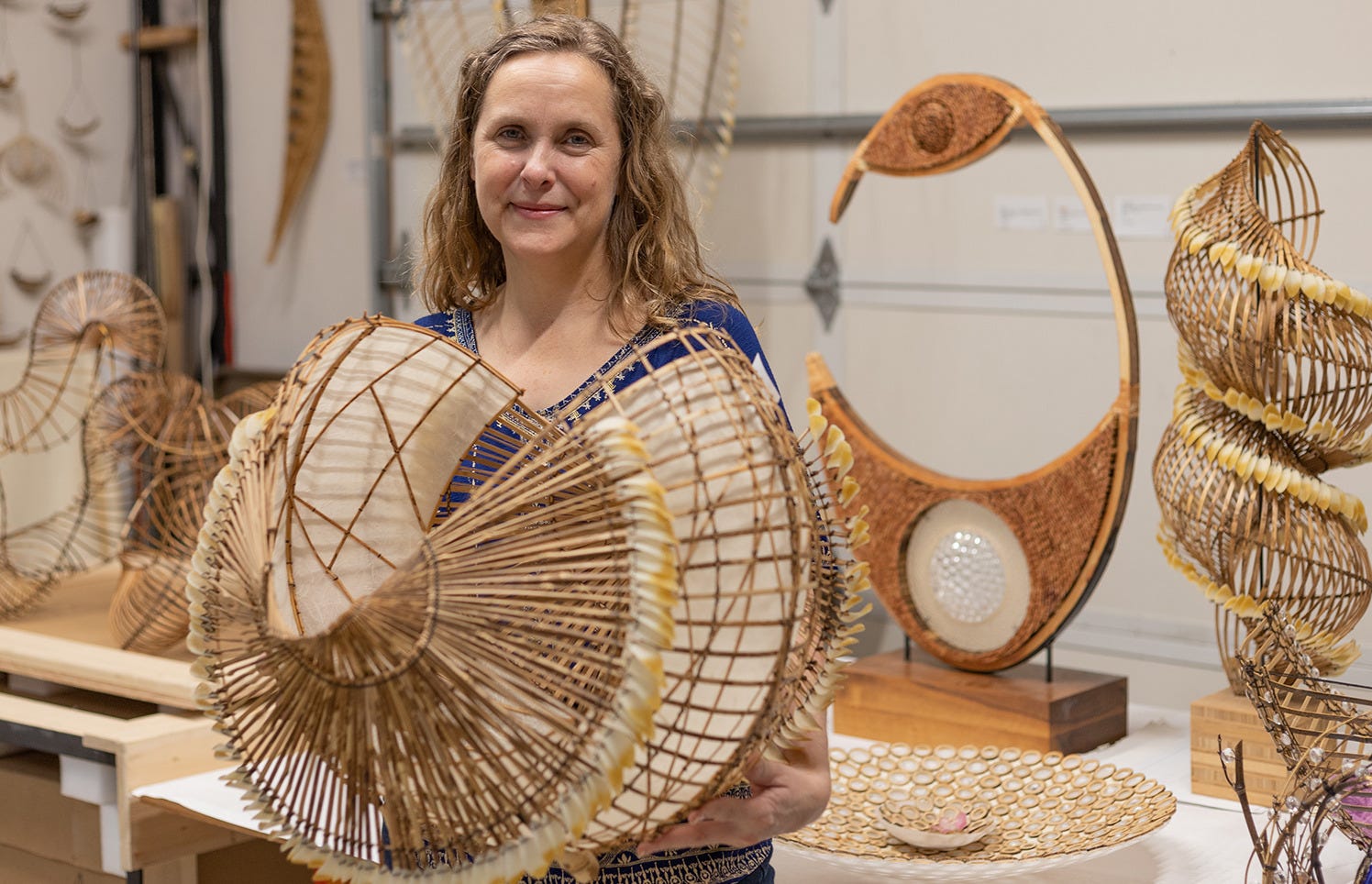
Another piece, which took her three years to make, is the spiraling, twisty piece, part of her Cloud series. (An art critic called one of the pieces in the series a roller coaster for the eyes.) The one regret Charissa expects she’ll have when she dies is she didn’t make time to lay on the ground and watch the clouds shape and shift.
I suspect she will find the time. This is the same woman who as a little girl found a chrysalis while walking in the woods, and thinking butterflies would emerge, put the mysterious object into a jar and set it next to her bed. One morning, she woke to find her nightstand painted bright green with tiny praying mantises.
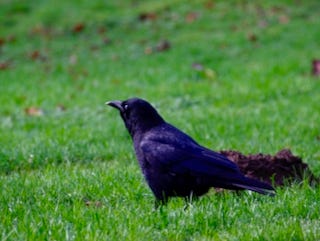
Portland is home to tens of thousands of American Crows, their cawing a ubiquitous soundtrack. During the summer, they feast on fallen plums, pears, and apples in people’s gardens, and on sidewalks and streets and anything else they can get their shiny beaks on. Late Fall, they scavenge gutters and trash cans. Come winter, I’m not sure what else they eat, but crows are notoriously resourceful and clever.
“So tell me about the crows,” I say.
Charissa gives me that impish, shy smile, when she’s about to share a dream or a story. “Okay, but can I tell you about the birds in my childhood, first?”
Her bright green-blue eyes get even brighter, as she talks about the magnificent Amazonian Double Yellow-Headed Parrot her mother, a world-renowned glass artist, brought home as a fledgling. Charissa, just finding her own wings as an artist, was mesmerized.
“I got to watch this bird grow up. I didn’t know I was an artist yet. I spent a lot of time drawing this parrot and other birds. I didn’t have a lot of wall space, so I hung the drawings in my closet. One day, a door-to-door vacuum saleswoman demonstrating her product for my mother opened my closet door. She saw all these birds staring out at her she said, ‘That is a lot of birds!’”
Charissa had just finished art school and was renting a carriage house in Northeast Portland when the crows incident occurred. One morning she noticed they were being particularly loud. Thinking nothing of it, she went about her day. The next morning they were at it again. The noise continued later that day and into the next morning. “It felt ominous. Obviously, there was an emergency of some sort,” she explains.
Outside, the crows were cawing and dive-bombing in the neighbor’s backyard, as if trying to divert a cat. Venturing next door, Charissa found a crow hanging upside down with one of its feet caught in netting. She fetched a garden gloves and a pair of scissors. Carefully, she clipped the crow free.
“When I tried to stand the bird up so it could get its bearings, it fell over. I found a spot up high, in a grape arbor and set the crow there.” She sat nearby for awhile to make sure the crow was safe, and then left the other crows to tend to its care.
The next day, the rescued crow was gone. For weeks, she’d come out and get into her car, and dozens of crows would follow, cawing as she drove down the street.
“Crows recognize specific people. I like to think they were thanking me. But maybe they were pissed off. Maybe the cat did get the rescued crow. Mind you, I didn’t see any sign of feather remains,” she says laughing.
Then she tells me she once had an internship at Bamboo Garden, a nursery in Milwaukee, OR, when a flock of American Goldfinch flitted in and out of the small bamboo forest she was watering. In a Snow White moment, one the birds landed and perched on her extended finger.
One sculpture captivates me more than the others. Intricately designed and crafted like all of her work, it evokes a wing or set of wings and eschews obvious realistic interpretations. But there’s a strong, felt presence to this particular sculpture, a vibration.
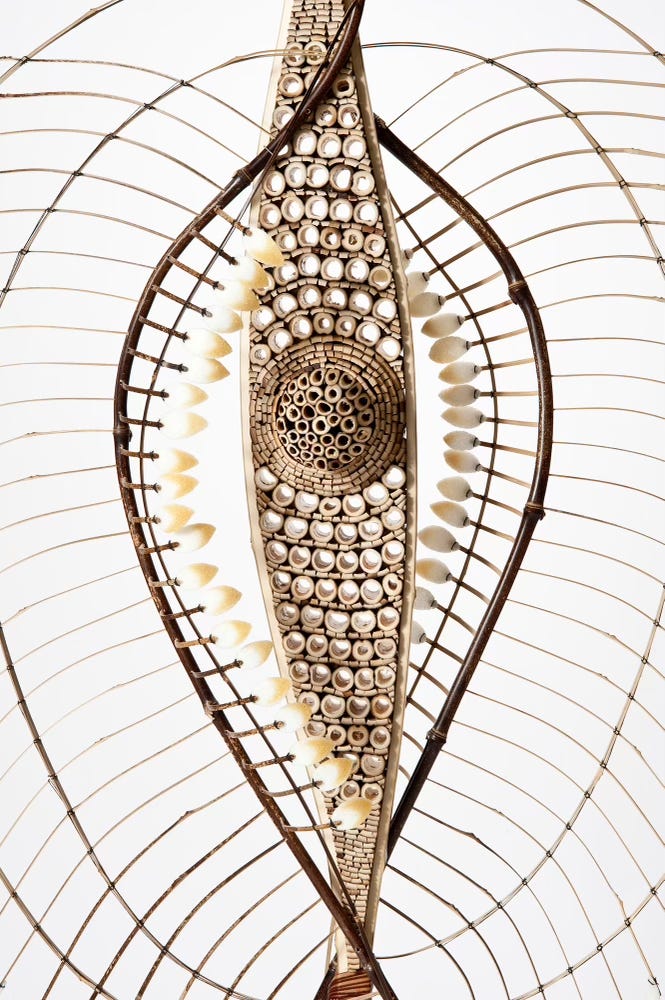
“It came to me in a flash, like a Divine interaction. It was given to me as an archetypal image… some kind of spirit/angel/bird,” she explains, confirming my feeling. “ My mind is geared towards structure, patterns and the materials I use, so the flash immediately translated into bamboo.”
It occurs to me the bamboo stems, or culms, Charissa watered at the nursery years ago and now cuts, heats, and shapes for her sculptures, are hollow like the bones of birds — and as a result, light enough to fly.
What is it about the deep connection we creatives often share with plants, birds, and other critters? What draws us to Nature’s many forms and sometimes She to us, and even before we pick up a pen, paint brush, hunk of clay, or a camera?
Naming Awe
Wing & Feather is one of Charissa’s few sculptures that doesn’t have a Latin name. Listen to this short audio clip of our conversation in her studio to find out why, and discover how art-looking can inspire either shame or awe.
You can see more of Charissa’s work here.
Fantastic
Fantastic